I barely open Gmail anymore.
The same goes for Canva. I rarely see my task management system, and even for presentations I usually do not log into the presentation software.
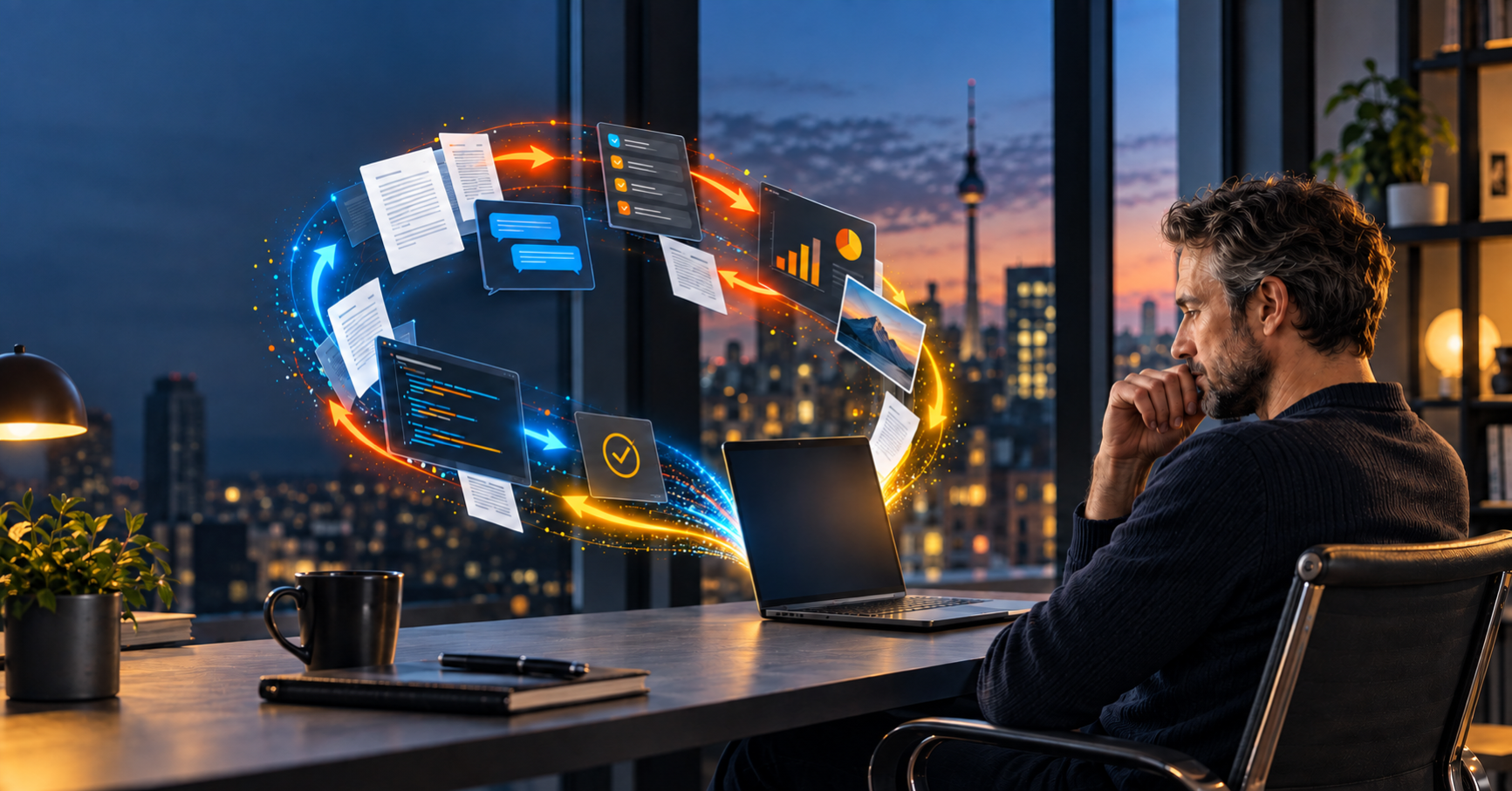
I tell my AI what I need. It operates the other applications for me.
AI has become control software for software.
That is remarkably efficient.
And slowly becoming a little boring.
Developers are seeing it first
Many barely write code themselves anymore. They describe the goal, let AI program it, and trigger the next step.
Even the review is moving to AI because no human can still read the full volume being produced.
The job remains. The actual activity gradually disappears.
The same thing is already happening in knowledge work.
The loop is closed
Consulting can now look like this: one AI creates the analysis. A manager has another AI review it. The client uses their AI to summarise and assess the report.
The questions go back to the first AI.
Everyone is busy. Hardly anyone still works on the content itself.CREATE → REVIEW → ASSESS → BACK TO AI
AI communicates with other AI through people. We become the interface, pass results along, and remain responsible at the end.
It is a strange new division of labour.
I know it from my own work. I use AI to create something. Then I use AI to check the first AI's result.
By my honest estimate, I stay inside my AI environment for about 80 percent of my work.
Doing becomes directing
I used to move between applications, search for information, transfer tasks, and assemble results across different tools.
Today I give the direction.
The system moves. I stay seated.
Directing is work, of course. The remaining 20 percent carries even more responsibility than before. The goal, context, judgement, and approval are mine.
Still, the feeling changes.
Writing becomes editing. Designing becomes choosing. Research and analysis become checking finished answers.
Doing becomes directing.
That sounds like a promotion. Less routine, more overview, greater speed.
It can also feel like a day full of control loops.
The feeling of having accomplished something yourself starts to disappear. Solving a problem, developing a text, or working on a design until it truly works used to provide a large part of the satisfaction.
Now the finished result often appears first. My contribution starts with the correction.
The profession hollows out
Work also includes the route to the result. Your own attempt, the failure, and the moment when you genuinely understand a solution.
When AI takes over that route, we mainly see the result. We can judge it as long as we still have enough knowledge of our own.
How will the next generation build that knowledge when they barely practise the activity itself?
How does a developer learn good code when they neither write it nor read it carefully?
And how does anyone develop judgement when one AI is already evaluating the work of another?
Once companies discover that more output is possible, saved time becomes a new expectation. People continue to work eight or twelve hours. They simply produce far more things that hardly anyone created, read, or understood themselves.
Very efficient.
Perhaps the profession disappears from daily life long before the position disappears from the organisation chart.
We remain responsible for results that have passed through our own hands and minds less and less. Eventually, an entire working day consists of instructions, reviews, and approvals.
The position still exists. The profession is hollow inside.
Then we have achieved maximum productivity.
And possibly a rather boring job.
When does work become so efficient that we disappear from it?